Case study · Waah Jobs (OLX Group)
From a 2.2-star app to 4.2, by fixing trust, not asking for stars
After a strong launch, Waah Jobs’ Play Store rating started sliding and nobody knew why. I treated the rating as a symptom, traced it to four root causes with research, and shipped the fixes that took it from 2.2 to 4.2.
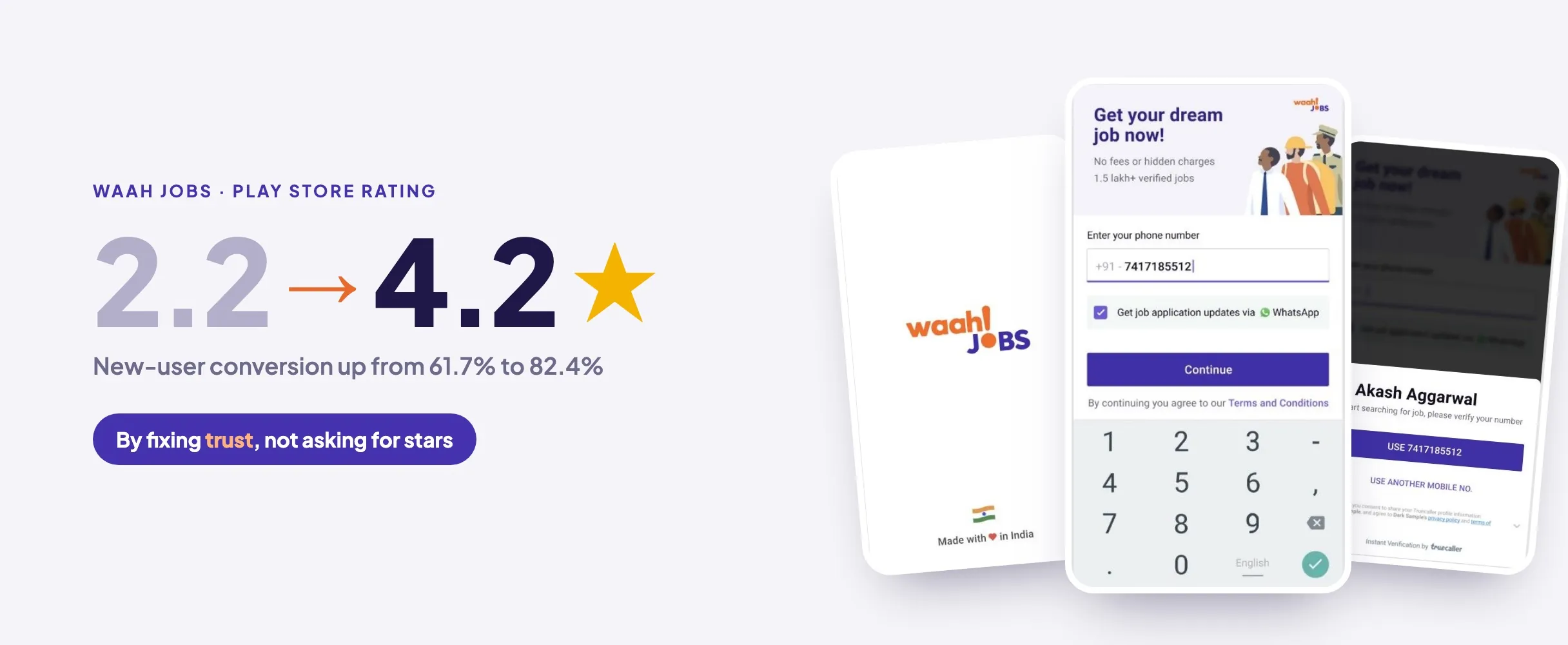
- 2.2 → 4.2Play Store rating
- 61.7 → 82.4%New-user conversion
- 4Root causes found and fixed
The problem
The rating fell, and nothing explained it
We launched the Waah Jobs app in March 2021, and it beat mobile web on every metric that mattered. Then the Play Store rating started to fall, and nothing in our dashboards explained why. For blue- and grey-collar jobseekers, many new to apps, that rating was the first trust signal before handing us their livelihood.
The easy brief was “get the rating back up”. With my design manager and PMs, I rewrote it: treat the rating as a symptom, find what was broken, and fix the experience.
We agreed on three goals before any research:
- Recover the ratingAs a proxy for restored trust, not as the target.
- Get more new users to a jobFewer drop-offs before they ever reach the homepage.
- Give users a way to reach usSo problems land with us, not in the store.
Signals
Every review told us where it hurt
I started with what users were already telling us: three months of Play Store reviews, NPS verbatims, report-a-job messages and Contact Us emails. Classifying every one gave a clear split, and a reassuring surprise: over a third came from loyal users. The numbers showed where it hurt, not why, so we took the open questions into user interviews.
Root causes
Four root causes, one we’d never have guessed
Bringing reviews and interviews together, four causes explained almost all of the damage. Three were experience problems:
- No feedback channelHRs didn’t answer and some employers committed fraud, and users had nowhere to report it but the store.
- Overwhelming onboardingJobseekers dropped off before reaching a single job, and rated the app out of frustration.
- No way to leavePeople who found a job couldn’t delete their account, so irrelevant alerts turned happy users into one-star reviewers.
Journey map
One journey map, three fixes
I placed every pain point on the full jobseeker journey, from finding the app to landing a job and beyond. That map became the team’s shared tool for deciding what to build: a new onboarding, an in-app rating flow that catches problems before they reach the store, and a way to delete or pause an account.
We started with onboarding. It touched every new user, and the funnel showed the worst drop-off came before anyone saw a job.
Onboarding
Onboarding: ask less, earn trust first
Past tests had already taught us a lot: our users distrusted social logins, rarely used email (just 6.4%), and abandoned long forms, with drop-off reaching 36% by the work-details step. So I challenged the core assumption: did we really need 20+ details before showing a single job?
We split onboarding from screening: ask only what’s needed to show relevant jobs, and collect the rest later, when it’s clearly worth giving. The full story has its own case study.
We shipped the leanest version of three ideas, tested first as a clickable prototype:
- Lead with trust“Verified jobs, no hidden charges”, because fraud was the fear we heard most.
- One-tap loginTruecaller verification removed the keyboard entirely.
- Short, contextual stepsIn place of a wall of 20+ fields.
Results
2.2 to 4.2, and it stayed there
The rating climbed from 2.2 to 4.2 and held above the peer median, because the in-app rating flow now catches problems while they’re still fixable. Onboarding conversion rose from 61.7% to 82.4%, and users finally had a way to reach us that wasn’t the review box.
Lessons
What I’d take into the next role
Three lessons I’m taking with me.
- A rating is a symptomEvery point we recovered came from fixing a journey, not from asking for stars.
- The cheapest research is already thereReviews, NPS and support messages showed us where it hurt before we ran a single interview.
- Interviews earn their keep on surprisesNo dashboard would have told us that one star meant “number one app”.
P.S. Next, we’re testing contextual nudges that ask for the rest of the profile at the moment its value is obvious.